
50 Minute 10K Training Plan
Your Breakthrough Schedule for Running 10 km Under 50 Minutes
Breaking 50 minutes in a 10K is one of the most satisfying milestones in distance running. It demands 5:00/km (8:03/mile) — fast enough to feel like real racing, but reachable for anyone willing to train with purpose. This guide walks through the training structure, weekly rhythm, and key sessions you need. When you're ready, plug your details into the Running Plan Generator to get a week-by-week schedule built around your race date.
Sample Weeks From the Plan
Below is a snapshot of the opening weeks from a sub-50 10K schedule. The generator produces your full plan — typically 10–12 weeks — calibrated to your race date, available days, and current ability. You choose 3 or 4 running days and the system does the rest.
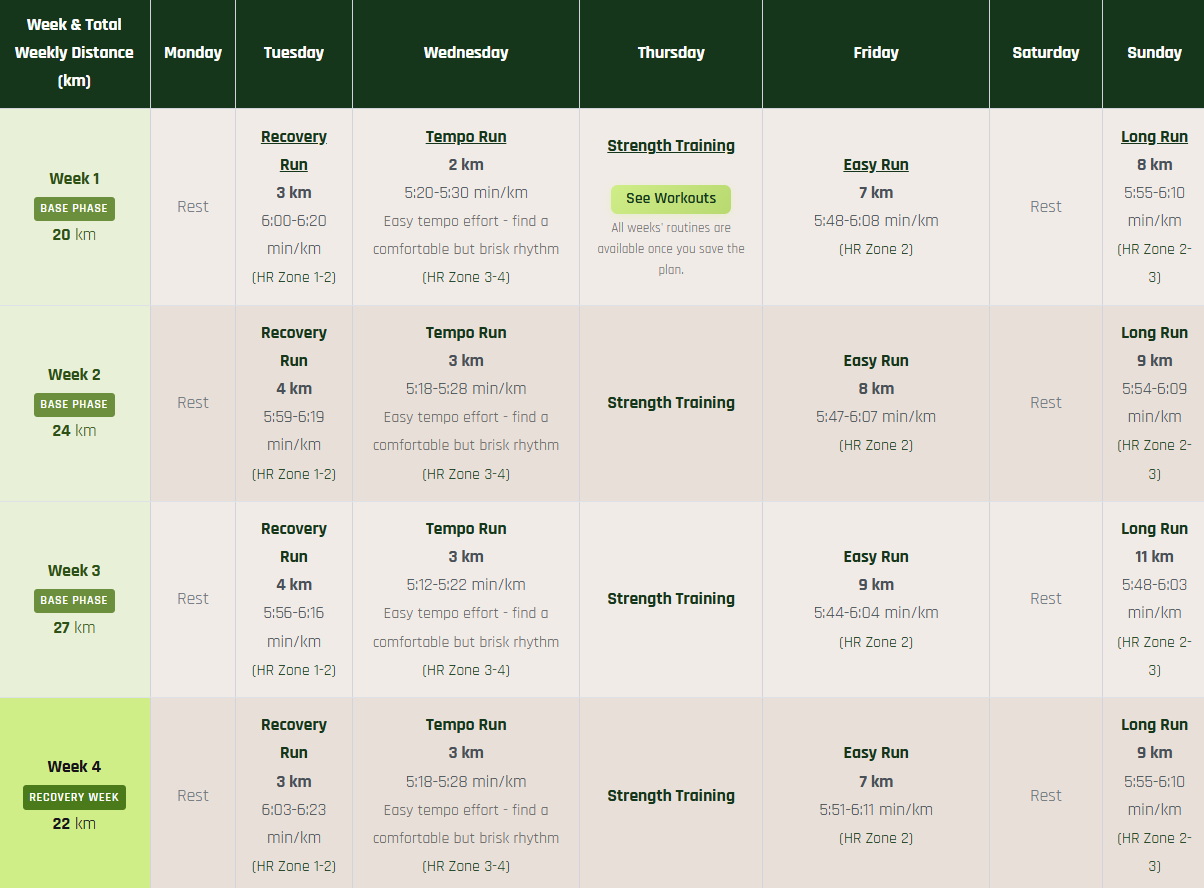
Every session has a reason. Easy days protect your legs, quality days sharpen your engine, and rest days let the adaptations stick. The generator handles the maths — you just follow the schedule and run.
Are You Ready for Sub-50?
A 50-minute 10K sits in a sweet spot: beyond casual jogging, but well within reach for motivated runners who have a few months of consistent training behind them. Before starting this plan, you should ideally tick most of these boxes:
- Running regularly: You've been running at least 3 times per week for the past 2–3 months
- Comfortable at 5K: You can finish a 5K in roughly 23–24 minutes, or close to it
- 10K experience: You've raced or run 10 km before, even at a slower pace (55–60 minutes is fine)
- No fresh injuries: You're healthy enough to add a modest amount of faster-paced running
Not sure where you stand? Use the Race Time Predictor to estimate your current 10K fitness from a recent parkrun or 5K result. If the number lands between 49 and 53 minutes, this plan is built for you. If you're further away, the 1-hour 10K plan is a better starting point.
How This Plan Builds Your 10K Fitness
3–4 Running Days Over 10–12 Weeks
Running a sub-50 10K is about efficiency — not volume. Three or four focused days per week give you enough stimulus to improve without grinding yourself down. Each week balances one quality session (tempo or intervals), one longer run, and one or two easier efforts. The plan progresses in blocks: a base phase to shore up your aerobic engine, a build phase to add race-specific intensity, and a taper to arrive at the start line feeling sharp and rested.
The Sessions That Matter
Easy Runs
The workhorse of your week. These low-effort efforts build aerobic capacity, reinforce good movement patterns, and keep your legs turning over without fatigue. Expect roughly 60–70% of your total running to fall here.
GuideTempo Runs
Sustained efforts at a pace that feels "comfortably hard" — typically 15–25 minutes around your lactate threshold. These teach your body to clear fatigue faster and hold pace when the race gets tough in the second half.
GuideIntervals
Structured repeats — think 800 m or 1 km reps with recovery jogs — at paces faster than race speed. They expand your aerobic ceiling so that 5:00/km on race day feels controlled rather than desperate.
GuideLong Runs
A weekly run of 50–75 minutes at easy pace that extends your stamina. You're not training for a marathon, but this run ensures the final 2–3 km of your 10K doesn't turn into a survival shuffle.
GuideRecovery Runs
Short, genuinely slow jogs the day after a hard workout. They promote circulation and help your muscles bounce back without adding meaningful stress. Think of them as active rest.
GuideStrength Work for Injury-Proof Running
Two short sessions per week — targeting glutes, calves, and core — help your joints absorb the impact of faster running and maintain form when fatigue creeps in. The plan generator can slot these around your running days. Strength Guide
Built-In Progression and Recovery
- Block periodisation: The plan moves through base, build, and peak phases so intensity arrives at the right time
- Recovery weeks: Every 3rd or 4th week dials back volume, giving your body a chance to absorb the work
- Race-week taper: A short, sharp reduction in the final 7–10 days so you toe the line feeling light and fast
- Flexible scheduling: The generator fits everything around your available days and race date
Know Your Training Paces
Running the right pace on the right day is what separates productive training from junk miles. Here are the approximate training zones for a 50-minute 10K goal — use our calculators to fine-tune them for your fitness.
| Session Type | Pace (per km) | Pace (per mile) | Purpose |
|---|---|---|---|
| Easy / Recovery | 5:50 – 6:20 | 9:24 – 10:12 | Aerobic base, recovery |
| Long Run | 5:30 – 6:00 | 8:51 – 9:39 | Endurance, time on feet |
| Tempo | 4:50 – 5:05 | 7:47 – 8:11 | Lactate threshold |
| Intervals (800–1 km) | 4:25 – 4:45 | 7:07 – 7:39 | VO2max, speed reserve |
| Race Pace | 5:00 | 8:03 | Goal 10K pace |
These numbers are starting points. Plug a recent race into the calculators below to get paces matched to your current ability rather than a generic table.
Free Tools to Dial In Your Numbers
Build Your Sub-50 10K Schedule
Enter your race date, choose 3 or 4 running days, and the generator builds a personalised 10–12 week plan with every session mapped out. Download it free or upgrade for tracking and editing tools.
Running Plan Generator
Set your 10K target, pick your days, and get a complete training schedule built for your race date.
Create Your PlanTrack & Adjust
Drag sessions around, log completed runs, and watch your consistency build week by week.
Open DashboardGo Premium
Unlock progression analytics, detailed session breakdowns, and extra plan customisation.
See FeaturesRace Day: How to Execute a Sub-50 10K
Training gets you fit; pacing gets you the time. A 50-minute 10K requires discipline in the opening kilometres. Here's how to approach the race itself:
- Start controlled: Aim for 5:02–5:05/km in the first 2 km. The adrenaline will make 5:00 feel easy — don't fall for it.
- Settle in: Kilometres 3–7 are where the race happens. Lock into 5:00/km and stay relaxed through the shoulders and hands.
- Use a negative split: If you have anything left at 7 km, start winding the pace down toward 4:55. Use our race pace calculator to plan your splits beforehand.
- Final push: The last kilometre is about commitment. You've done the work — trust your legs and hold form to the line.
Why Train With YearRoundRunning?
Every plan from the generator is rooted in proven training principles: progressive overload, polarised intensity distribution, and periodised recovery. Over 2,000 runners have already used our tools to build structured plans — from first-time 5K runners to experienced racers chasing personal bests. Whether 50 minutes is your first real time goal or a stepping stone to something faster, the generator adapts to where you are right now.
Explore more training resources: the full 10K training guide covers everything from choosing a race to peak-week preparation. The VO2 max calculator can give you a fitness benchmark to track as you train. And when you're ready for the next challenge, check out our 45-minute 10K plan.