
TREADMILL RUNNING: THE PROS AND CONS
Treadmills get a bad reputation. A lot of runners call them the dreadmill, avoid them completely, and treat indoor running like it does not really count. I get why. It is boring, it is repetitive, and you are staring at a wall instead of moving through the world.
But I think that view misses a lot. A treadmill is a tool, and it does some things better than the road ever will. It also does some things worse. Once you know which is which, you can use it properly instead of either avoiding it or leaning on it too much.
So let's go through it. Benefits first, then the downsides, then how it actually compares to running outside.
By Quentin van Bentum • August 2026
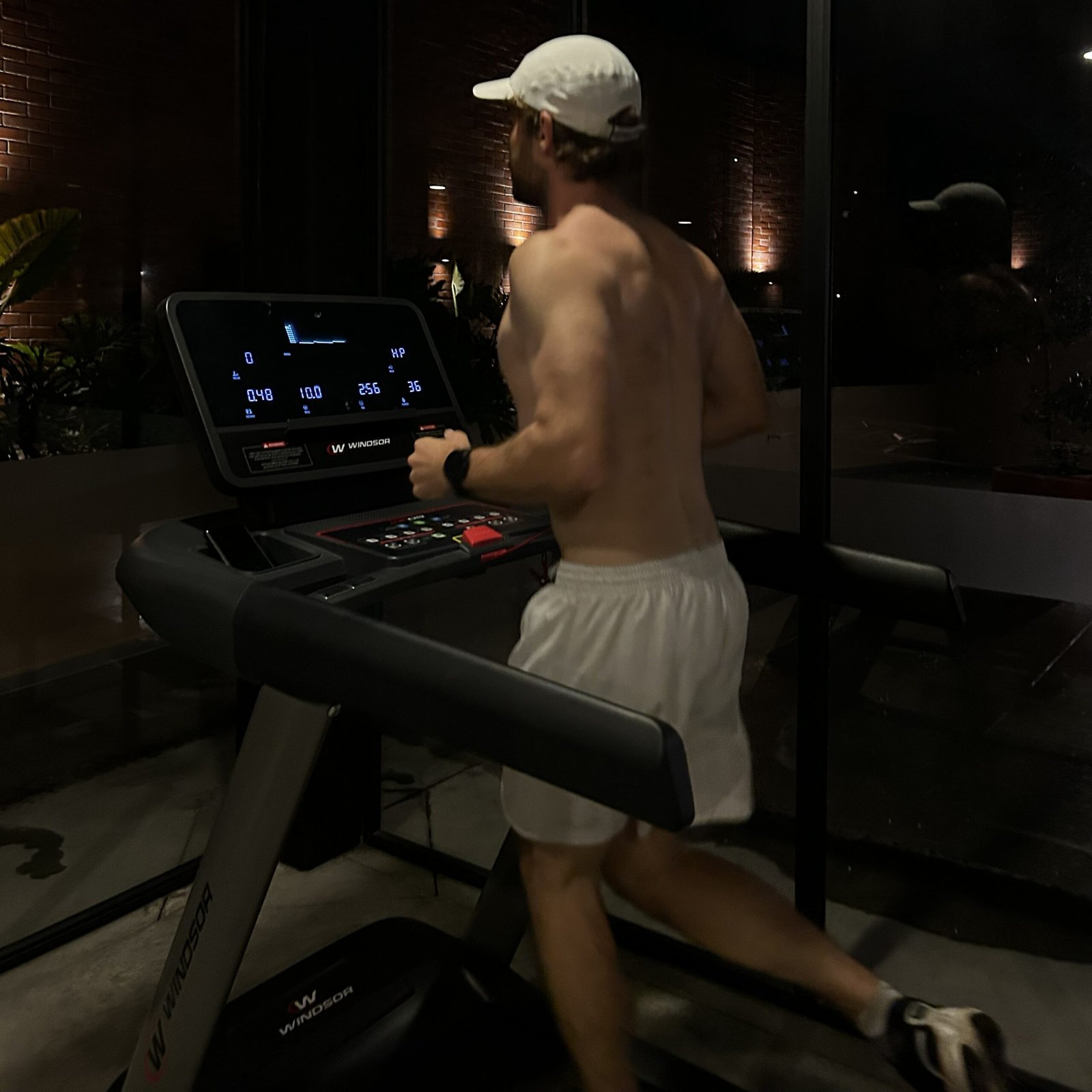
The benefits of treadmill running
There are four that actually matter to me. Mental strength, lower impact, elevation on demand, and control over speed.
1. It builds mental strength
This is the one people complain about, and it is exactly why it works. Treadmill running is boring. There is nothing to look at, nothing changes, and you cannot zone out into scenery. You just have to keep going.
That is not just a feeling either. Research comparing indoor and outdoor running keeps finding that the same effort feels harder on a treadmill. In one study, runners on a treadmill had the highest perceived exertion, the slowest 5 km time, and the lowest satisfaction of any setting tested, compared to an indoor track and an outdoor route (Harte and Eifert style setting comparison, Psychology of Sport and Exercise). Other work has shown that at the same measured intensity, runners rate their effort roughly two points lower on the RPE scale outdoors than they do indoors (PLOS ONE, 2024).
A large review of treadmill versus overground studies found the same pattern in performance terms. Runners consistently did worse on set distance and set duration trials on a treadmill, and they picked slower speeds when asked to run at a fixed level of effort (Sports Medicine, 2019).
So a treadmill session at a given pace costs you more mentally than the same pace outside. That sounds like a downside, and on race day it would be. In training it is a feature. If you can hold a tempo on a treadmill while bored out of your mind, holding it outdoors with something to look at is easier. You are training the part of you that wants to quit when nothing is fun.
2. Lower impact
Treadmill belts are more compliant than concrete or asphalt. You feel that, and the research backs up part of it.
Peak vertical force is roughly the same on a treadmill as it is overground, because your legs adjust their stiffness to compensate. What does change is loading rate, which is how fast that force arrives. One study found average vertical loading rate was about 50 body weights per second lower on a treadmill than on concrete (Sports Medicine, 2019). Another study measured tibial impact acceleration and found it was 36.5% greater running overground than on a treadmill at the same speed (Medicine and Science in Sports and Exercise).
That is the shock going up through your shin, and less of it is a good thing if you are carrying a niggle, coming back from a bone stress issue, or just stacking a lot of weekly mileage on hard roads. It is not a magic injury shield, but it is a genuinely softer place to put some of your easy volume.
3. You can add elevation gain whenever you want
This is the one I think is most underrated, especially if you live somewhere flat. I have trained in places where finding a real hill means driving 40 minutes. On a treadmill you press a button.
And uphill running is not just hill practice. It is a way to get a hard aerobic session with much less impact. A study measuring loading rate across different slopes found that at the same metabolic demand, vertical loading rate dropped by 27% at a 5% slope and 54% at a 10% slope compared to running on the flat. At maximal aerobic intensity the reductions were bigger still, around 53% at 5%, 63% at 10%, and 73% at 15% (Sports Medicine Open, 2022).
So you get the same energy cost in less time, with a fraction of the pounding. That is a very good trade for a lot of runners.
Incline work also holds up as real training. A study on well trained distance runners found that high intensity intervals done at a 10% grade improved running economy markers just as much as the same intervals done on the flat (Journal of Strength and Conditioning Research, 2014). It did not beat flat training, but it matched it, which means you are not giving anything up by using the incline.
If your goal race has climbing in it and your local roads are pancake flat, the treadmill is the only way to prepare for it properly.
4. Easy control of speed, and learning how a pace feels
This is the practical one. You set a number and the belt holds it. No traffic lights, no going too fast on the downhill section, no accidentally drifting 15 seconds per kilometre off target because you felt good for two minutes.
For interval and tempo work that is genuinely useful. If a session says 5 x 1000 metres at a specific pace, the treadmill will not let you cheat and it will not let you overcook the first rep either. You get all reps at the pace you intended.
It is also the best tool I know for learning what a target pace feels like. Most runners are bad at this. Ask someone to run marathon pace by feel and they will often be way off. Spend a few sessions locked at that exact speed on a belt and you start to recognise it. The breathing, the cadence, the effort. That memory transfers to race day.
One thing worth knowing here. Because there is no air resistance indoors, the same belt speed is slightly cheaper than the same speed outdoors. The classic fix is a 1% incline, which came from a 1996 study that found a 1% grade matched the oxygen cost of outdoor running across a wide range of speeds (Jones and Doust, Journal of Sports Sciences, 1996). Newer work has questioned how universal that is, with some studies finding treadmill running is actually more demanding than outdoor running regardless of grade (Current Issues in Sport Science). I would not obsess over it. Set 1%, treat the number as a guide, and pay attention to effort as well as pace.
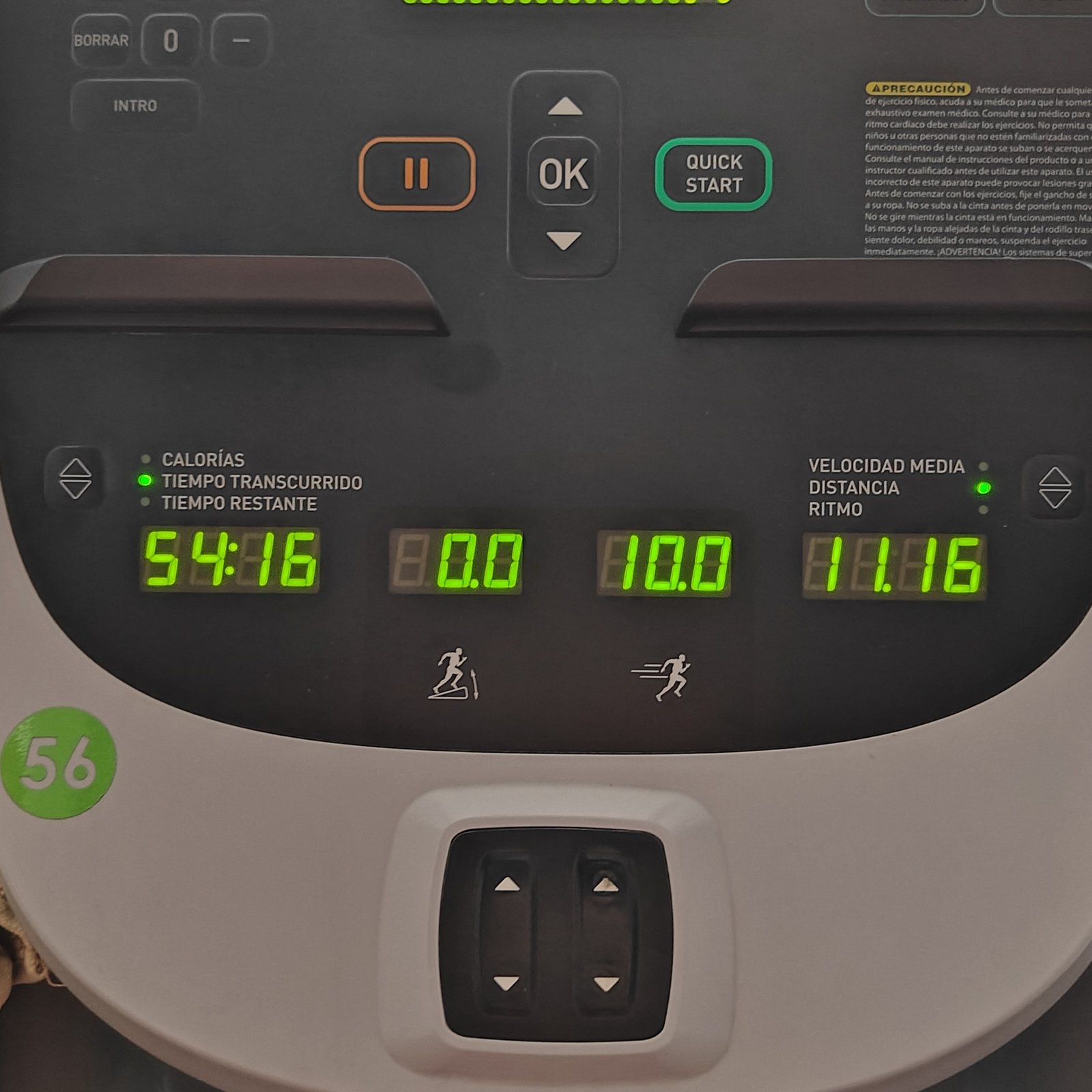
The downsides
Now the other side. There are three that I think actually matter.
1. Form can be harder to maintain
Your gait does change on a treadmill. The 2019 review of 33 studies found most measures were broadly comparable, but not all of them. On a treadmill, foot ground angle at footstrike was nearly 10 degrees flatter, contact time was longer, knee flexion range during stance was greater, vertical movement of the body was lower, and peak propulsive force was smaller (Sports Medicine, 2019).
None of that is dangerous. But it does mean you are practising a slightly different movement pattern, with a slightly flatter landing and less push off. Add in the fact that the belt is moving under you rather than you driving over the ground, and it is easy to fall into a passive, shuffling stride without noticing.
It also gets worse as you get tired, and there is no natural feedback telling you off. Outside, sloppy form usually shows up as slowing down. On a treadmill the belt keeps going at the same speed no matter how badly you are running. So you can grind out 40 minutes of increasingly poor mechanics and the display will still say you hit your pace.
My honest advice here is to stay engaged. Check in on your posture, keep your cadence up, and do not stare at the numbers for the whole session. Also avoid holding the handrails, because that changes everything about how you are loading your body.
2. No external conditions
Outside, nothing is ever the same twice. The road cambers, there is a pothole, the wind picks up at the exposed corner, it rains, the surface changes from asphalt to gravel. All of that is doing something for you.
Uneven ground forces constant small adjustments through your feet, ankles and hips. Research on runners over trail like undulating terrain found that they do not consciously pick the flattest spots to land on. Instead their bodies handle it through leg and joint compliance, adjusting passively step to step (eLife, 2021). That is a skill, and it is one you can only build by being on ground that is not perfectly flat and predictable. A belt is the most predictable surface there is.
Wind is the other one. It is not a small factor. Pugh measured the energy cost of overcoming air resistance at around 8% of total energy cost at 5000 metre speed, and up to 13 to 16% at sprint pace (Journal of Physiology, 1970). Running into a headwind on race day is a real physical demand, and if you have never trained in one you will not be ready for it.
Same goes for heat, cold and rain. Racing in bad weather when all your training was in a climate controlled room is a rough surprise. Those conditions are annoying, but they are part of the sport and you adapt to them by being in them.
3. No downhill training
Most treadmills only go up. A few decline models exist, but the vast majority of runners do not have access to one, so descending is basically off the table indoors.
That matters more than people realise, because downhill running is a completely different demand. Your quads work eccentrically, lengthening under load to brake you, and that causes real muscle damage and soreness. The upside is that your body adapts to it fast. A single downhill session protects you against damage in later sessions, which is called the repeated bout effect, and the protection can last for weeks (Frontiers in Physiology narrative review, 2020).
In other words, downhill running is one of the highest value things you can do to protect your legs, and the treadmill cannot give it to you. If your race has any descending in it, or even just long stretches of road that trend downwards, you have to get that outside. Uphill treadmill work does not prepare your quads for going down.
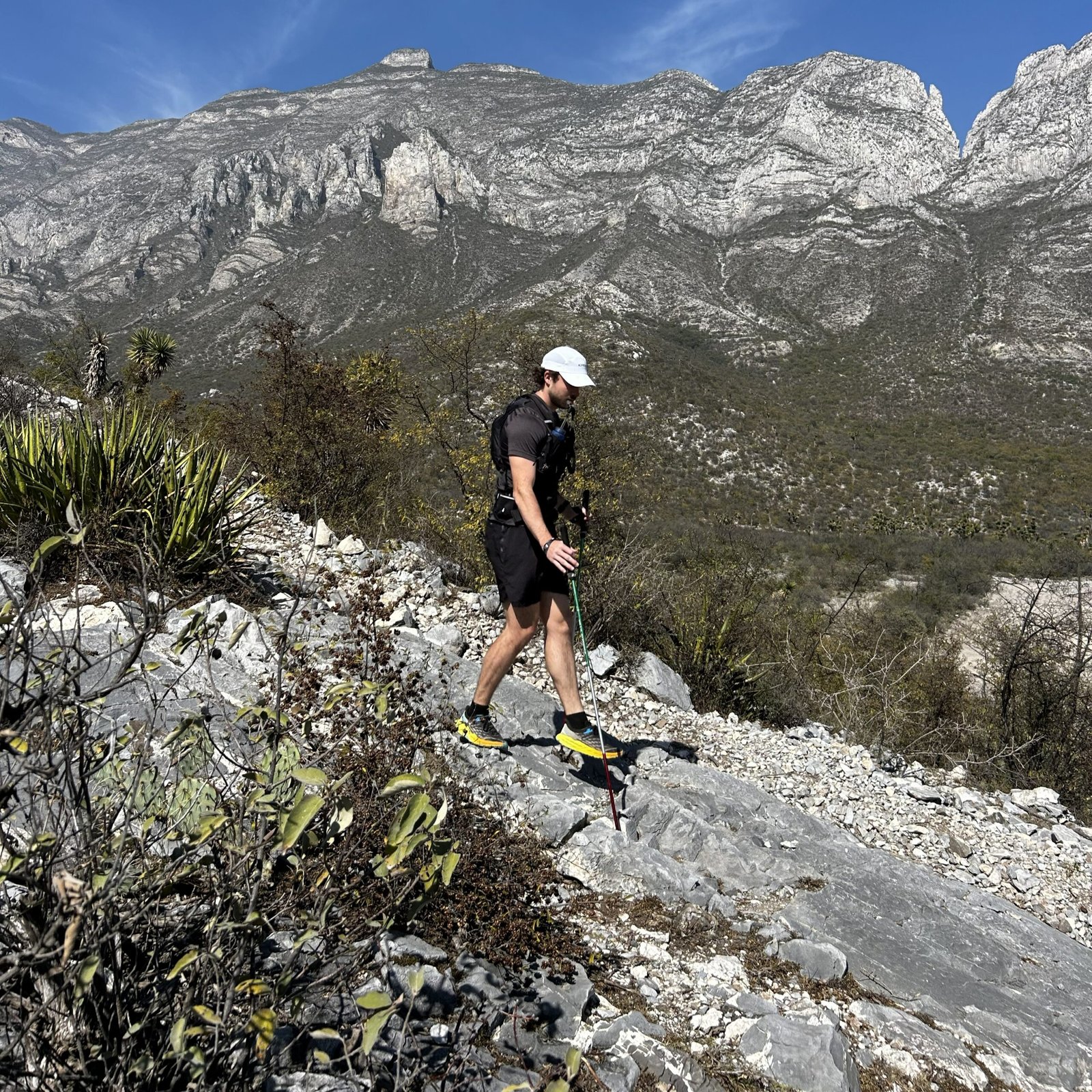
Treadmill versus road running, side by side
Here is the short version.
| What you want | Better on a treadmill | Better outdoors |
|---|---|---|
| Exact pace control | Yes | No |
| Lower impact loading | Yes | No |
| Guaranteed elevation gain | Yes | Depends where you live |
| Learning what a pace feels like | Yes | Harder |
| Downhill and eccentric strength | No | Yes |
| Wind, weather and heat tolerance | No | Yes |
| Foot, ankle and hip stability on uneven ground | No | Yes |
| Race specific pacing skill | Partly | Yes |
Look at that list and the pattern is pretty clear. The treadmill wins on control and on reducing load. Outdoors wins on everything to do with real world specificity.
My take
The benefits far outweigh the downsides. I think a treadmill is a genuinely useful addition for any runner, and using one once in a while will not hurt your training. In some cases it will improve it.
But it should not replace outdoor training. That is the important part. Treat it as an additional method for more precise, controlled, targeted work, not as a substitute for the road.
In practice that means using it when it is the better tool:
- Interval or tempo sessions where you want an exact pace held for every rep
- Easy or recovery miles when your legs are beaten up and you want less shock
- Hill work when you live somewhere flat and your race is not
- Learning target race pace by feel before you have to hold it for real
- Days when weather or safety genuinely make outdoor running a bad idea
And keeping outside for everything else. Your long runs, most of your weekly volume, anything with downhill in it, and any session where you need to practise pacing yourself rather than having a machine do it for you.
Use it as a tool for specific jobs and it earns its place. Use it as your whole training and you will show up on race day underprepared for the things a belt never asked of you.
Read next
If you want a plan that fits your actual schedule, mileage and available training days, that is what the generator is for.
Sources
- Van Hooren et al. Is Motorized Treadmill Running Biomechanically Comparable to Overground Running? A Systematic Review and Meta-Analysis of Cross-Over Studies. Sports Medicine, 2020.
- Leg Impact Accelerations And Ground Reaction Forces During Running On A Treadmill And Overground. Medicine and Science in Sports and Exercise.
- Correspondence Between Values of Vertical Loading Rate and Oxygen Consumption During Inclined Running. Sports Medicine Open, 2022.
- The Effects of Incline and Level-Grade High-Intensity Interval Treadmill Training on Running Economy and Muscle Power in Well-Trained Distance Runners. Journal of Strength and Conditioning Research, 2014.
- Jones AM, Doust JH. A 1% treadmill grade most accurately reflects the energetic cost of outdoor running. Journal of Sports Sciences, 1996.
- Should a 1% gradient be used to equate the metabolic cost between treadmill and overground running? Current Issues in Sport Science.
- Perceived exertion can be lower when exercising in field versus indoors. PLOS ONE, 2024.
- Effects of cognitive strategy and exercise setting on running performance, perceived exertion, affect, and satisfaction. Psychology of Sport and Exercise.
- How human runners regulate footsteps on uneven terrain. eLife, 2021.
- Pugh LGCE. Oxygen intake in track and treadmill running with observations on the effect of air resistance. Journal of Physiology, 1970.
- Downhill Running: What Are The Effects and How Can We Adapt? A Narrative Review, 2020.
This article is for general training information and is not medical advice. If you are returning from injury or dealing with ongoing pain, speak to a qualified professional before changing your training.